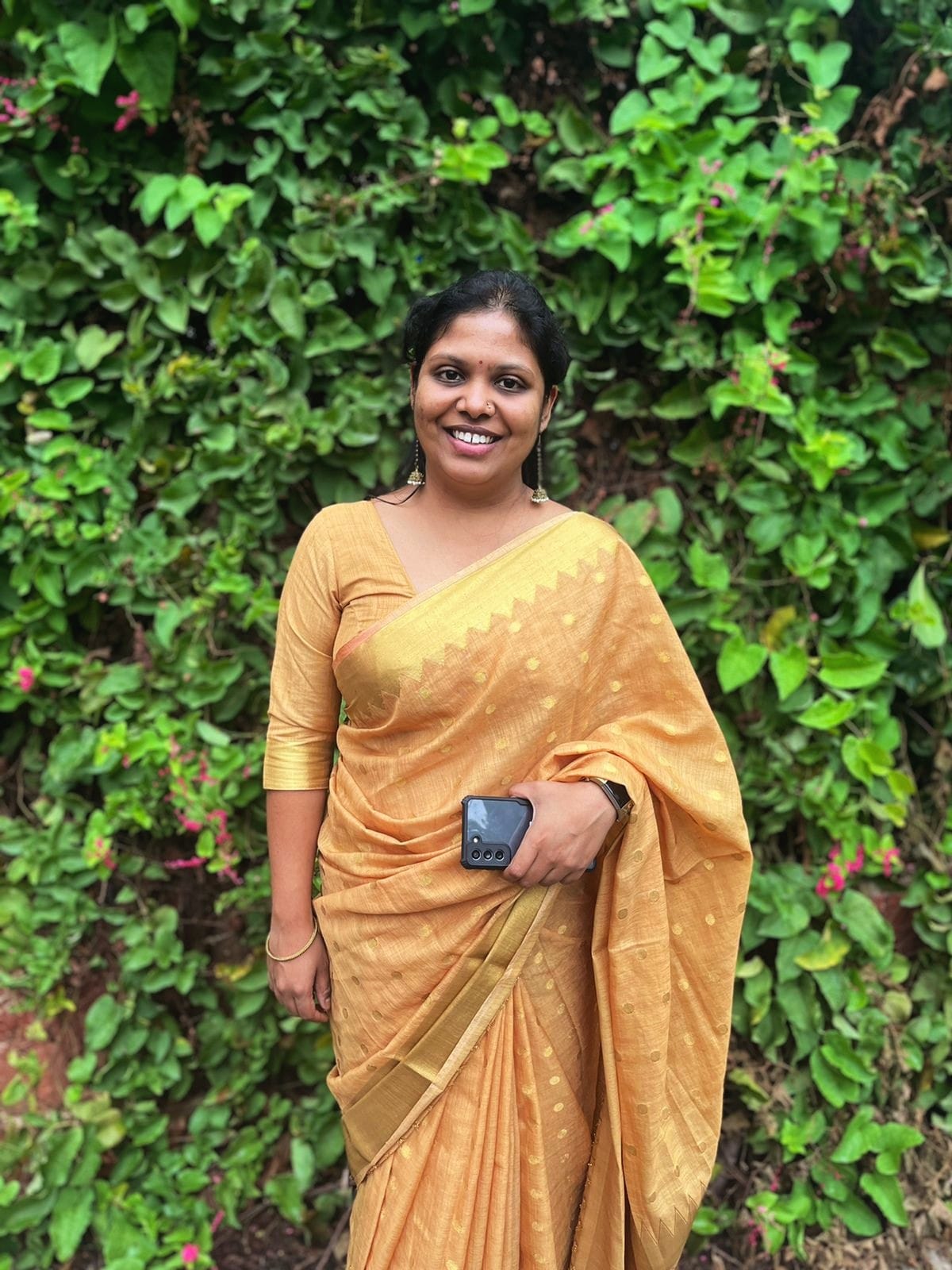
Ashwini Obulesh is a lawyer who founded Dhwani Legal Trust, a Bengaluru-based not-for-profit organization that provides affordable, reliable, and approachable legal aid, assistance, and support to vulnerable groups, primarily women from marginalized communities, who cannot afford legal representation. From domestic and gender-based violence to child custody to PILs to tribal and Dalit rights, Ashwini’s work often spills over to human rights. A gold medallist from the National Law School of India University (NLSIU), Ashwini began her legal career with corporate law in Mumbai, but soon found herself drawn back to the grassroots legal aid work she’d championed as a student volunteer. She’s also a visiting faculty at NLSIU, teaching ‘Litigation Advocacy and Drafting, Pleadings, and Conveyancing.’ In this interview, she talks about helping people navigate systems designed to exclude them with the kind of purpose that turns personal conviction into systemic change.
How did you find your way into legal aid and social justice lawyering?
So, the background really is that from my very first year, I was deeply involved with the Legal Services Clinic, a student-run body where we conducted legal awareness sessions across the state. We’d perform skits that exaggerated a legal or social problem and then ask the audience, often school students, what went wrong. Then, we’d explain the law from there. Apart from awareness, we also referred people to lawyers and did legal research to support those cases. That’s where my interest in legal aid began. In fact, I ended up heading the clinic in my fifth year.
Even though I started my career in corporate law— doing project finance in Bombay — I took a break later to attempt the UPSC, and that’s when I began litigating under Professor Ravi Varma Kumar, former Advocate General of Karnataka. While working with him, and apart from litigation, I also started doing a lot of human rights work, where we used to go to the villages of Karnataka to conduct training programs for the marginalized communities. That reignited my passion for social justice.
What inspired the creation of Dhwani Legal Trust, and what gap were you trying to address?
As I started doing legal awareness sessions on my own — working with NGOs, speaking on child sexual abuse, conducting training for teachers — I realized it was time to give this work a name. So I registered Dhwani as a trust. At its core, through Dhwani, we’re trying to fill a gap in access to quality legal aid, especially for women facing domestic violence and sexual abuse.
There’s a lot of mistrust in the system and in lawyers that persists among people. Many of them don’t even know how to find a lawyer unless they’re privileged. While state mechanisms exist, they’re not always effective. I mean, if they were, we wouldn’t have so many women walking into our office every day, often in desperate circumstances.
What does Dhwani look like today, and what’s the scope of your work?
We started off very small, being completely self-funded by donations from friends and family. Now, Dhwani is a team of 10, including eight lawyers, and we’ve reached a stage where we’ve been funded by philanthropic organizations.
At present, our work spans all courts in Karnataka, barring commercial matters. We’re empanelled with the High Court Legal Services Committee and recently partnered with Parihar, an initiative of the Bangalore City Police, to offer legal aid at women’s police stations. We also run a weekly cell in the Commissioner’s office to handle domestic violence, custody, maintenance, and divorce cases.
I’d like to add that we do have quite a dedicated team at Dhawani that goes very much out of its way to ensure that access to justice is a reality. It’s an extremely diverse team with people from all possible backgrounds across religions, castes, and genders. But I think the passion — or, you can call it obligation, maybe — as a lawyer to do good, pro bono work, is a common thread running through us all.
What are some of the biggest challenges you’ve faced in this work?
I think the biggest challenge for me has been the scale of the problem. The rise in domestic violence, child abuse, and sexual assault is overwhelming; if we look at the NCRB (National Crime Records Bureau) data, there has, quite clearly, been a steady rise. As such, we’ve naturally handled heartbreaking cases of women thrown out of homes, children unable to attend school because there’s no money for fees, survivors unable to pay rent or buy food… the list goes on.
Another challenge, I’d say, is when the survivor’s idea of justice doesn’t align with what the legal system can offer. For instance, women who’ve been physically abused but still want to return to their husbands. It puts us in a difficult position: do we file a case, knowing it might harm reconciliation? Or do we hold off, knowing it may leave them without protection? So, these are some challenges we see, but we completely understand that this has everything to do with the conditioning and the societal structure itself in terms of patriarchy and misogyny that exists in the world.
What kind of change are you hoping Dhwani can bring about?
We hope to expand across Karnataka, and eventually, India. We want to be the ‘next-door lawyer’ for anyone in need of legal aid. During Covid19, we ran a helpline with 40 volunteer lawyers, tackling everything from domestic violence to hospital overcharging. It showed us that there are passionate lawyers out there, and we just need to create the platform for them.
So, we hope to create a just world where everyone lives with dignity; that’s our core mission. Practically, we want to increase access to justice, especially for people from marginalized communities, by helping them navigate complex legal systems without being intimidated or repelled even by the justice system.
We want to be the ‘next-door lawyer’ for anyone in need of legal aid.
Ashwini Obulesh