
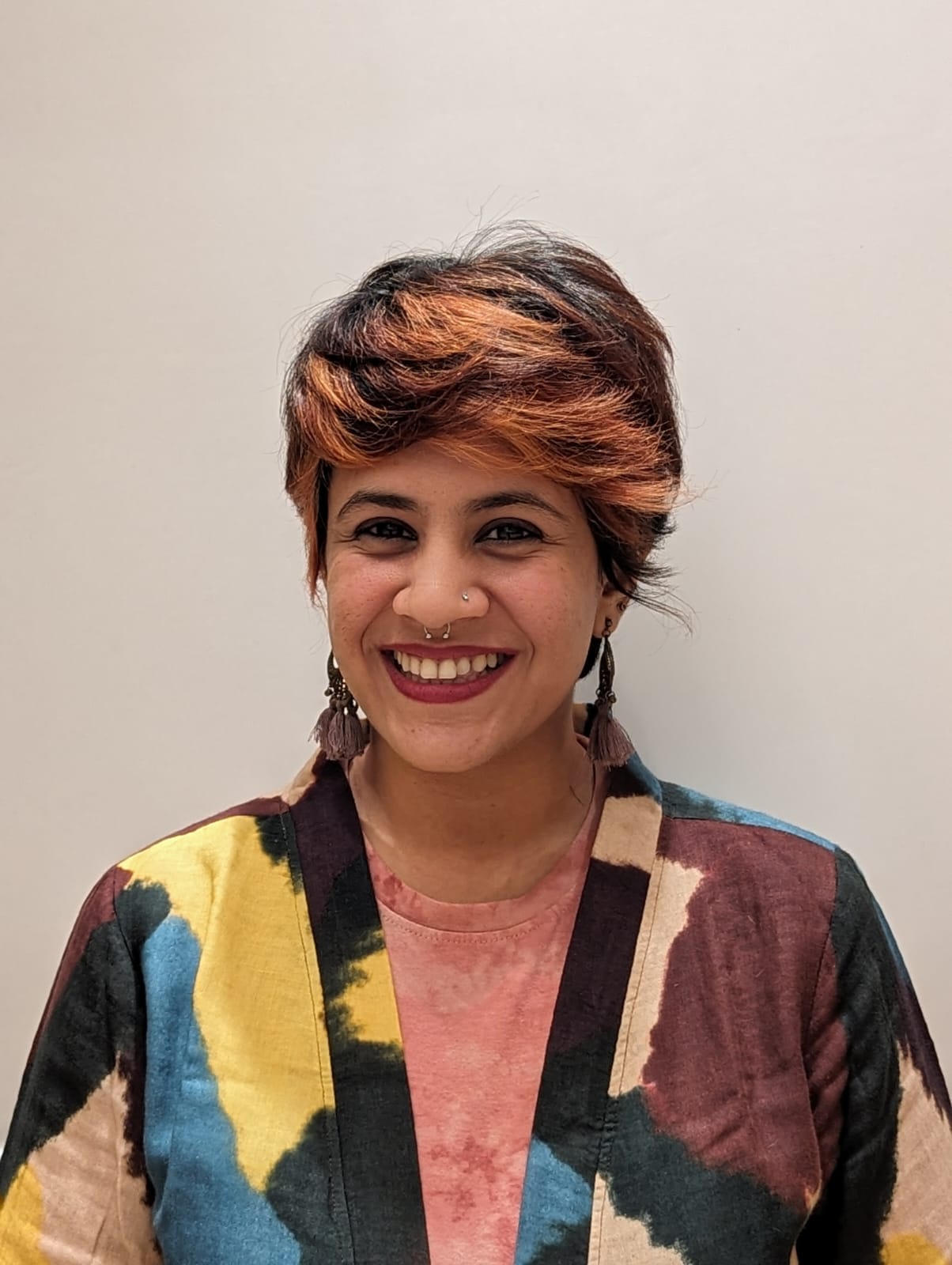
Richa Vashista — a queer, neurodivergent psychologist with over a decade of experience — is the founder of Leher Mental Health, which supports South Asian communities globally through inclusive, trauma-informed, and liberation-centered care. Leher follows an evidence-based approach that prioritizes individual uniqueness and agency, combining person-centered, evidence-based practices with a strong commitment to intersectionality and non-pathologizing, affirming care.
Tell me about your organization, and what drew you to the work you’re doing now.
I didn’t get support for a long time, and Leher Mental Health was born out of years of wanting to create a space for people like me.
As a queer, neurodivergent psychologist, I was tired of seeing mental health spaces that didn’t really see people like me, where the support was either pathologizing or completely disconnected from the lived realities of caste, gender, queerness, disability, and more.
There wasn’t one dramatic “aha!” moment, but more like a series of small waves nudging me, conversations with clients, burnout in activist circles, the isolation of private practice, and the constant feeling of “there has to be another way.”
I started Leher because I wanted to create the kind of space I wish I had access to, one that is compassionate, intersectional, and deeply human.
What gap do you think you’re filling, and why does that feel urgent or necessary to you right now?
So many mental health services are still designed around Western frameworks or upper-caste, neurotypical norms; they don’t always translate to the lives we live here — especially for those of us at the margins. I think Leher fills a gap by centering intersectionality in practice, not just in theory.
We’re trying to make space for people who’ve been made to feel too complex, too sensitive, too much, to say, “Actually, you’re not too much. The system wasn’t built with you in mind. Let’s start there.”
That feels urgent because the mental health crisis isn’t just about access, it’s also about belonging, safety, and care that doesn’t demand you shrink yourself to be helped.
What’s next? Where do you see this work — or yourself — going in the next couple of years?
To be honest, the switch from being a psychologist in private practice to suddenly running an organization was a lot.
I had to unlearn this idea that to be a “good leader,” I had to have all the answers. I’m still learning how to build in public, how to ask for help, how to grow something without replicating the hierarchies and burnout I want to dismantle.
One thing that’s helped through the process is learning to slow down. I’ve learned that sometimes rest is the most strategic thing you can do, especially in a sector where urgency can burn people out before anything meaningful gets built.
What’s next? Where do you see this work — or yourself — going in the next couple of years?
For starters, I want us to expand what we think “mental health” even means beyond therapy, beyond diagnoses. I hope Leher becomes a reminder that healing can look like community, creative expression, rage, rest, and everything in between.
We’re trying to challenge the idea that mental health has to be individual, clinical, or always “productive.”
I want to help shift the field toward something more liberatory, especially for queer, trans, neurodivergent, and multiply marginalized folks in South Asia.
What’s next? Where do you see this work — or yourself — going in the next couple of years?
I haven’t thought that far ahead, to be honest; I’m trying to go with the flow. But having said that, I’d love for Leher to grow without losing its soul, to scale care in ways that still feel personal and community-led. Maybe that looks like an in-house training program, maybe more public-facing campaigns, maybe more accessible support spaces outside of therapy?
Personally, I want to keep learning, from the people I work with, from community, and from my own mistakes. I don’t have a 5-year plan, but I do have a gut feeling I’m following. That feels enough for now.
I also want people to know that we don’t have to be fully “healed” to build healing spaces. I’m still unlearning, still growing, still figuring it out. And I think there’s power in showing up anyway, messy, honest, and committed.
We’re trying to make space for people who’ve been made to feel too complex, too sensitive, too much.
Richa Vashista