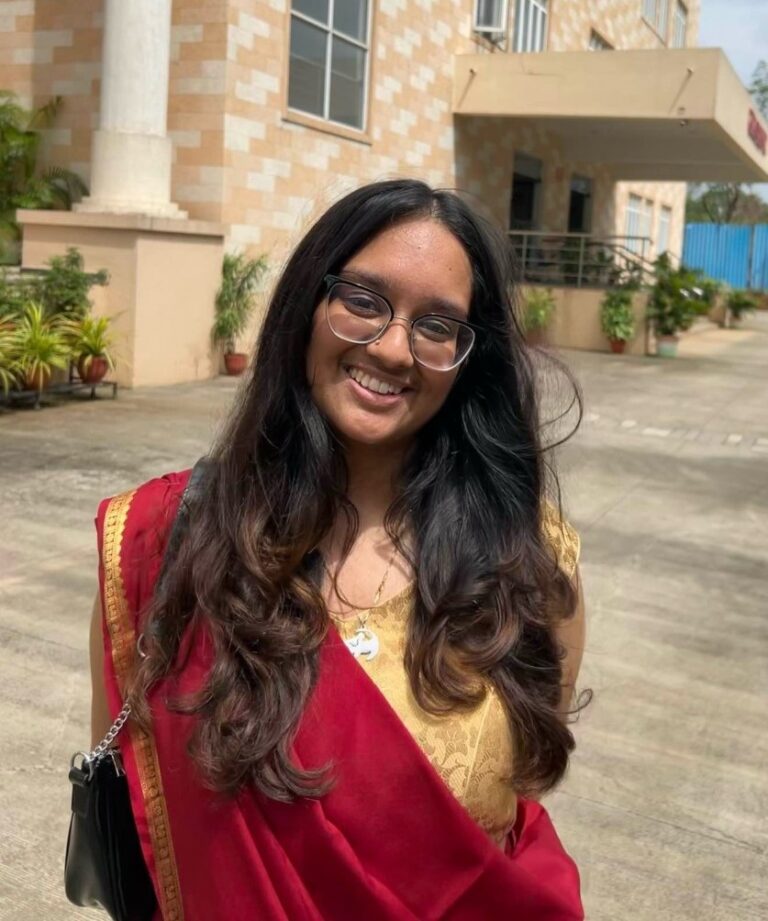

Apekshita Varshney, the founder of HeatWatch, talks about why climate justice must include labour rights, how India’s 90% informal workforce is left out of the heat conversation, and what needs to change, urgently.
Tell me about your organization, and what drew you to the work you’re doing now.
I run HeatWatch, and I’ve been doing this for about two and a half years now. The work really sits at the intersection of labour rights, climate justice, and health justice. What pushed me to start it was a combination of my experience as a journalist and then as a development sector practitioner.
What gap do you think you’re filling, and why does that feel urgent or necessary to you right now?
As a journalist covering urban issues and climate, I experienced extreme heat firsthand. I fell ill while reporting in rural Maharashtra, Uttar Pradesh, and the NCR, and it took me a long time to recover. But beyond my personal experience, what struck me was how little public conversation there was around the actual impact of heat on people. There were maybe some overarching mentions of heat action plans, but not much on how people were actually being affected.
Then, as someone trained in urban studies, I also noticed a huge gap in how we think about hazards. Flooding is visual — its destruction is right in front of your eyes. But heat has a slow onset. It’s not optically devastating. The photos in newspapers are of people covering their heads or drinking water, which doesn’t communicate the same urgency.
So, this lack of visibility plays into how the state and society respond to it, and you’re trying to address that?
Exactly. Because heat doesn’t look catastrophic, there’s very little awareness or action around it. I remember talking to construction workers about heat-related illnesses — like heat stroke, which is fatal — and they were completely unaware that something like that could even happen. Nobody had ever told them. That lack of basic, life-saving information made it clear to me how deeply systemic the issue is.
It also highlighted how top-down our current approach is. Most of the discourse around heat is framed by policy or institutional action plans. Very little of it emerges from the people most affected. What kind of challenges do they face? What solutions do they see? Those questions are rarely asked.
Would you say that makes HeatWatch’s focus unique — this attempt to centre the ground realities of vulnerable communities?
Yes. The gap we’re trying to fill is that there is very little local-level awareness. The demands of those who are the most impacted are rarely platformed, or even taken into consideration, because of their marginalized identities. Meanwhile, most heat action plans don’t take into account deeply rooted social vulnerabilities, like caste identity and informality.
We’re a country where 90% of the workforce is informal, and yet our policies seem to assume that people can just “choose” to stay indoors when there’s a heatwave warning. But missing a day’s wage isn’t an option for them.
So, you’re saying there’s a disconnect between policy and lived experience. How does HeatWatch bridge that?
We work with grassroots organisations, local groups, and unions to build that bridge. We hold awareness sessions for workers and also co-produce research using both qualitative and quantitative methods. That helps build a narrative from below, and more importantly, gives some power to people to demand change.
Because right now, that kind of discourse is entirely missing from how we talk about climate adaptation in India. Heat is not just a climate issue; it’s a labour issue, a gender issue, a health issue.
What are the most urgent changes HeatWatch is advocating for?
The most immediate one is this: no one should die of a heat stroke. It’s a fatal condition where your body temperature rises beyond control unless you get emergency medical care — like being immersed in ice or cold water. We already know who is most vulnerable. The tragedy is that we don’t even have accurate data to grasp the scale of the problem.
Last year, we did a study where we tracked heat stroke deaths reported in English-language media across 17 Indian states. We found 733 deaths. But in a Parliament response, the government only admitted to 360. That kind of undercounting speaks to the larger systemic neglect.
What are some longer-term structural shifts that you think are needed?
A big part of it is working conditions. We’ve studied gig workers in Hyderabad, for instance, and found that access to basics like water and toilets is still not there. But that’s not unique to gig workers; we see the same across informal sectors. So improving wages, working conditions, and access to healthcare is critical.
Because of informality, poor wages, and the way workers are treated as dispensable, there’s very little focus on their health or safety. That has to change.
You’ve mentioned that women working from home also bear the brunt of extreme heat. Could you talk more about that?
Yes, this issue goes beyond just construction sites or delivery workers. A large number of women are home-based workers. They work in cramped, poorly ventilated indoor spaces where temperatures can be 5-6 degrees higher than outside in greener areas.
These women are disproportionately affected, and their livelihoods also need to be protected. So we’re pushing for stronger social protection systems — things like paid leave, health insurance, access to cooling infrastructure.
What does accountability look like for the state and the industry?
We want governments to take meaningful action to protect the people most exposed to extreme heat. That includes accurate data collection, targeted support systems, and robust early warning systems that actually work and take ground realities into account. But we also need employers and industries to think beyond profit margins — to consider the wellbeing of everyone in their value chains, including contract workers and gig workers.
And at a broader level, we need to rethink how our cities are built. Our infrastructure, our economy… it’s all tied to fossil fuel-heavy development. We need to imagine different, renewable, more sustainable ways of living and working. The challenge is enormous, but this is where the work begins.
Heat is not just a climate issue; it’s a labour issue, a gender issue, a health issue.
Apekshita Varshney