

In India, equality at work still depends on permission slips from the past.
By Kalpita Wadher
The G, H, and backspace keys on my laptop’s keyboard recently stopped working, rendering my laptop almost unusable. Both keys are extremely important for the English language, and typing without them made my work impossible. In these two sentences themselves, there are 6 Gs and 7 Hs. It drove me to the point where I was considering replacing the entire keyboard, which, by the way, is the only option even for just one key – but I’ll debate the right to repair on another day. Another option was to replace the entire laptop, which I was also seriously considering. Until one day when it struck me to remap the function of said keys to other less-used keys like print screen or one of the alt or ctrl buttons. After this, my laptop has been working perfectly fine.
This made me realise that my laptop already had the ability to perform said functions, but my inability to accommodate made the task impossible. I recently studied the social model of disability, which says that most visible disabilities are society’s inability to accommodate the disability instead of the person. For example, if we all knew sign language, then being deaf would not be considered a disability at all. Language is nothing but a mode of expression, and sign language is equally that.
That got me thinking: what if we applied this lens to other social problems?
Take, for instance, the news from Jharkhand. The state government recently amended the Factories Act, 1948, to allow women to work on night shifts. My first reaction was disbelief: Really? Women didn’t have permission to work night shifts in factories? That can’t be possible in the 21st century.
And yet – lo and behold – it is.
Let me tell you a little story about power, politics, and who gets to allow whom. The Indian legislative system follows three lists: Centre, State, and the Concurrent List. Each list contains the subjects on which laws can be made by the Centre or state. In the concurrent list, both unequally share power. Labour falls here.
In 1948, we enacted the Factories Act. Section 66 of the Act states that no woman shall be “required or allowed to work in any factory except between the hours of 6 A.M. and 7 P.M.” This essentially translated into a blanket ban on night shifts for women. Because labour is a concurrent subject, some states have amended this section to allow women to work at night. But unless a state actively passes such an amendment, the default remains No.
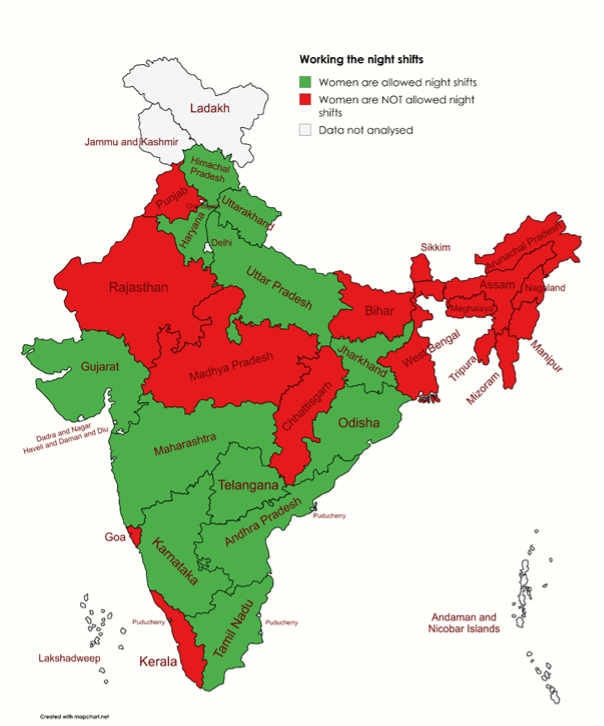
There has been some opposition to this default. In 2005, a bill was introduced in Parliament to amend this section, but no further action was taken. In Kerala, a 2021 judgement allowed a woman to work despite the restriction. But these are exceptions, not the norm.
And that’s the point. Our laws should be progressive enough for society to catch up. But when the law continues to use the language of allowing women, it reinforces dependence rather than equality. The future of gender equality looks bleak if the framework is still about permission rather than rights.